Posts

Showing posts with the label Poetry Songs

Curio No. 37

Image
    Uses the Japanese Hiro Joshi scale exclusively--essentially natural minor with no 4th or 7th degree.    A thousand thoughts that trouble me dissolving into sadness as 1 gaze upon the moon— but not to me alone does autumn finally come tsuki mireba chiji ni mono koso kanashi kere waga mi hitorsu no aki ni wa arañe do   ***  AI-generated version in Japanese. Since I don't speak Japanese I can't attest to its accuracy.

Curio No. 32

Image
   From One Hundred Poems From Old Japan  Minamoto no Muneyuki  These mountain huts and hamlets are lonelier by far when winter comes around Just as the grass has withered, friends too have vanished—so it seems yamazato wa fuyu zo sabishisa ma sari keru hitóme mo kusa mo karenu to omoeba  AI-generated version (Japanese) 

Curio No. 21

Image
  Music to the 8th century Japanese poem Yamabe no Akahito Walking out on Tago Beach When suddenly I’m face-to-face With a sheet of solid white The towering peak of Fuji Crowned by snow Still falling now  Uses the Japanese Kumoi (Joshi) pentatonic scale at bar 13-26     Curio No. 21 by meta4s *** AI-generated versions:  

Tiny Houses

Image
An example of when prose is so musical you can use it as a lyric, in this case a October 5, 1899 William James letter. The music is AI-generated with words more spoken that sung. I think it works well. What would James think? I like the dead-pan elocution of the word "tiny". *** 10/5/1899 Letter to Mrs. Henry Whitman:             ...The land is bathed in greenish-yellow light and misty drizzle of rain. The little town, with its miniature brick walls and houses and nooks and coves and gardens, makes a curiously vivid and quaint picture, alternately suggesting English, Dutch, and Japanese effects that one has seen in pictures, all exceedingly tiny.... The land is bathed In greenish-yellow light And misty drizzle of rain The little town With its houses and coves Curiously vivid and quaint English, Dutch, and Japanese effects All exceedingly tiny

Sunken Willows

Image
  Artificial intelligence is obviously more capable of evoking emotions than it was only a year ago. With this song, it's typically a cut-up of various diary entries, in this case, April 28ths. It also references a passage from W.G. Sebald’s Rings of Saturn , where he mentions sunken willows. The original title was Through Brundall on to Cantley , but the sunken willows image captured the mood perfectly. I also think that it's a nice combination of poetry and lyric, where they can kind of function the same way, with fragments of images, such as the fragmented nature of dream imagery. It's what's termed as “Sebaldian”--having to do with Sebald’s dreamy prose. The photography is also interesting, and was taken in the mid to late 19th century in the same area as the path that was taken in Rings of Saturn through towns in East Anglia (Cantley). The playlist also includes an ambient mix, which takes just the vocal set against various field recordings of wind and waves.  ...

Deep and Cold

Image
An example of going from prose to poetry to lyric. AI music generation is a challenge because you have to take so much out in order for it to work with the algorithms. It's an interesting process, but if I were to create a song manually, it certainly would not have this kind of simplistic harmony, but it does work as a finished recording.  Seed:  4/21/2022 New idea inspired by Rebecca Solnit’s Field Guide For Getting Lost, particularly the “Blue Of Distance” bit. The prose sounded musical. The poem: The blue on the horizon Is a special place where light unfolds It is a deeper space; there's more sky to hold But it is deep and cold And in the deep and cold it rolls In the deep and cold it rose Touch the soil The soil, the land Touch the water Then touch the sand As you catch the sun And walk the beach Heard from on the cliffs An echo's reach

Music By Baudelaire

Image
  "Composers were fascinated by Baudelaire’s poetry, as it so closely resembled music. Disciplined in technique, clear in structure, and highly descriptive in terms of imagery, his poetry held great appeal for musicians and composers alike." https://interlude.hk/charles-baudelaire-1821-1867-i-have-cultivated-my-hysteria-with-pleasure-and-terror/   There's nothing more earthy than to sit down with an existing poem and set it to music while strumming a guitar.  I chose the first verse of Music by Charles Baudelaire , and became a bit of a sea chantey. (The other stanzas don't sound particularly musical). Music doth uplift me like a sea Towards my planet pale, Then through the dark fogs or heaven's infinity I lift my wandering sail. My process of translating the music in language to composed music is to find the rhythms in the language first, then map a melody, then harmonize. You can go a step further and map new words in place of Baudelaire's, add other ver...

The Music of Language

Image
On Twitter, someone posted a clip of Anthony Hopkins reciting the last stanza of the Dylan Thomas poem Do Not Go Gentle Into That Good Night , in a post related to Brexit. I was moved by the natural prosody and the natural rhythms in the words in its recitation. It is written in the form of a villanelle , a ballad-like song with no fixed form. Both Thomas and Hopkins seem to evoke a march rhythm. In both cases, I am interpreting it in an A Dorian context (Am/D). "Rage, rage against the dying of the light" can be a repeating refrain, even softly under the rest of the poem. It's a kind of "soft" protest march. At a slower tempo, it could be dirge-like. Audio export from Finale

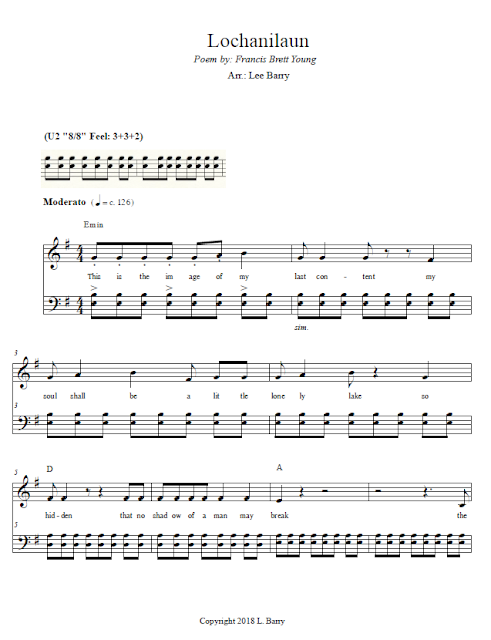
Lochanilaun

Image
A song I wrote, using the poem " Lochanilaun " by the English poet Francis Brett Young (with a few tweaks). Young also wrote the poem " Dust ", which Danny Kirwan of Fleetwood Mac adapted on the album "Bare Trees." I've always loved that song for its harmonic and structural angularity, and only used just part of the poem. Very often poetry veers too far away from lyrics and shifts into art-song form, which I don't want. This is the image of my last content: My soul shall be a little lonely lake, So hidden that no shadow of man may break The folding of its mountain battlement; Only the beautiful and innocent Whiteness of sea-born cloud drooping [falling] to shake Cool rain upon the reed-beds, or the wake Of churned cloud [of a churning cloud] in a howling wind's descent.  For there shall be no terror in the night When stars that I have loved are born in me, And cloudy darkness I will hold most fair; But this shall be the end of my delight Th...

Mnemonic Walks

Image
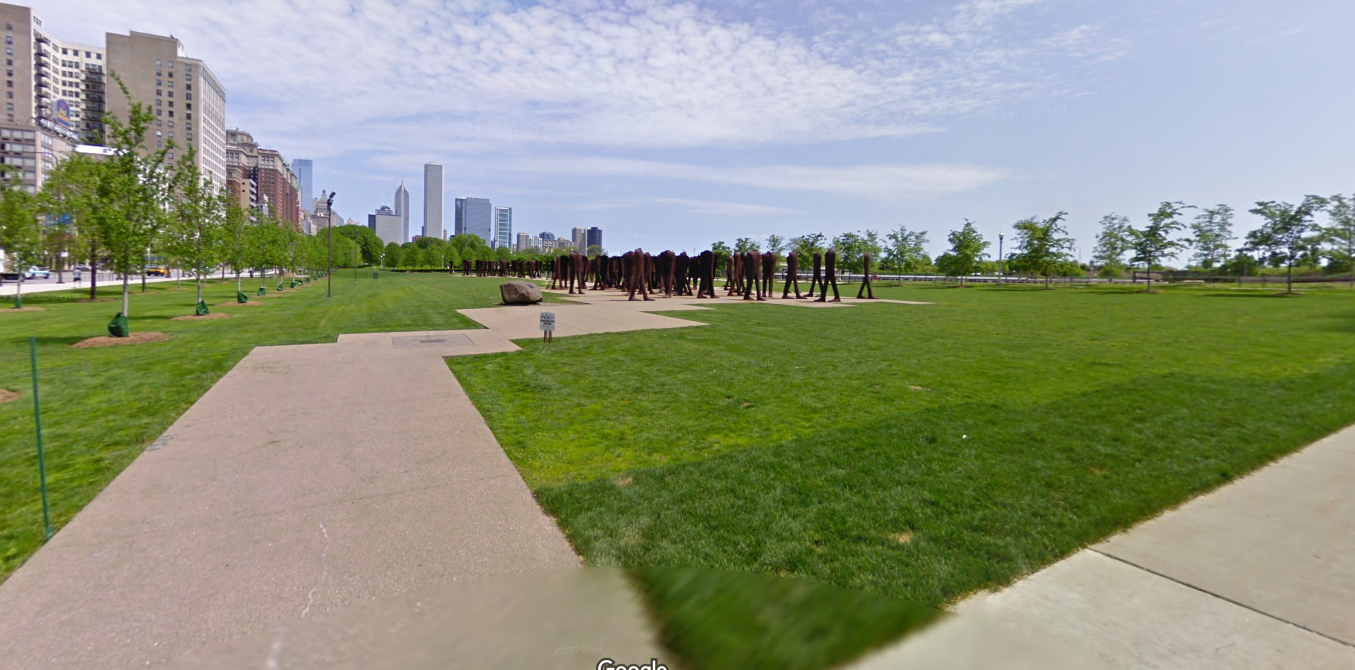
Mnemonic Walks (2014) A conceptual series that fuses place with poetry by linking each line in a poem to a specific geolocation, for purposes of memorizing the poem. Once memorized, both place and poem have a circularity in memory. It's not about the technology per se, but rather what the technology allows us to do manually with memory. (Technologies are extension points for the brain.) Mnemonic Walk, No. 1 North on Michigan Avenue from Roosevelt: Beachhead, first walk on land Legs walking in a square Memories of aquatic breathing--inspired without air Mother bought them warm garments--Montgomery Ward wares For equestrian events on holidays--riding on the mares 8th Cavalry riding--rhythms over black stone squares Reached its destination--as the Congress took its share The artist begins to sketch--as cats on the prowl will dare Standing in an attitude of defiance--with tourists there to stare Towers twin now air--Parallel lines, a...