Posts

Showing posts with the label Bass Lines

Be Bach (AI Version)

Image
Typically I would have transcribed a sax solo and attempt to play it on the bass. In this case I paraphrased a Bach Partita in a Be Bop style and for the bass, but this is a sax version of the head played on the bass.   

Curio No. 100

Image

March 6ths

Image
3/6/2004   They now teach turntable technique at Berklee. They always make reference to Jazz: parents always thought it was noise, and eventually it became a studied art form. Jazz was just another point of the downward spiral of music tradition, yet is one of the highest forms of musical expression.  3/6/2005   Watched documentary on PBS about The Mamas & the Papas. John Phillips was a really good songwriter when “songwriter” was defined as someone who was actually a musician, rather than someone who comes up with a clever and cunning marketing strategy (or beats/loops).   ["Discuss how "song", "songwriter", and "composer" have been defined over time"]  3/6/2012 The objective of a composer is to make complete musical statements—however long they take. Faster tempos will have a natural tendency to decrease total duration, as the musical ideas lose kinetic energy more quickly, especially if parts are played manually (as opposed to looping them...

Figured Basses (Shortet)

Image
It's an interesting time in music, now with AI on the scene, which is fun to experiment with, but I like to do the manual things as well to keep it in balance. And all you have to do is write is a minute's worth of music. It's a form of "maintenance practice"--practicing just enough to keep the idea of skill alive. This is the latest shortet (for Sum IV.1 ), based on a 1992 bass piece. Shortet No. __ (Figured Basses) – meta4s by meta4s The 41/8 version (Bass Only)   Figured Basses (41-8 Version) – meta4s by meta4s 3 ways to interpret the groove As compound meters:  One meter per bar: As one bar of 41/8:

Cool AI Bass

Image
Bass is all about the low. AI bass lines can be pretty good, but you can also play your own parts against them. This is really simple, with a Rocco Prestia feel:  

Steel Curves (Drop 31)

Image
    More Drop 31 tuning (E-G#-D-F#). There are 4 bass parts on this. No effects are used. The sound is ultra-dense and heavy, as if a stampeding herd of basses (Bass Bison).      

Algorithm Jockeys (Short)

Image
  Tuning: E-G#-D-F#. Octaves are fingered as in standard tuning, which makes the tuning seem familiar, but the major third on the top remaps the fingerboard for interesting possibilities. (2/17/2024)

Drop-C Tuning

Image
What I call the "C-Bass" is essentially a transposing instrument where the key is a major third above concert pitch. So D Dorian is played as in F# Dorian.

Led Boots

Image
 As an homage to Jeff Beck, I had to transcribe. It's actually written by Max Middleton.

Power Of Three

Image
  A 6-bar bass line that modulates down by a major third 3 times, then repeats. Score: Power Of Three by meta4s

Sonatina in G Major (1983)

Image
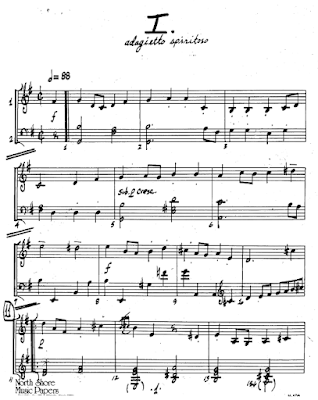
Composed in 1984 in a Mozart-age-9 style. If you like challenges on the bass, this could be for you. The recording is very lo-fi, recorded on a cassette 4-track with (ugh) reverb on it. I also did the calligraphy. I used to enjoy engraving. It was a rigorous as composing and performing. The use of the treble clef is non-traditional and unusual but as far as I know electric bass players don't read tenor clef, and this piece does a lot of switching in both parts. The third movement is the most fun to play. The Recording:   The arrangement for string quartet done a few years later: 

Ace of Black Hearts

Image
    I call this "soft-slap", which is essentially playing a steady back-beat of muted notes with the right hand, and playing a chord tone with the left. This is also a derivation from the song of the same title:  https://leebarry1.bandcamp.com/track/ace-of-black-hearts Ace of Black Hearts (Soft Slap) by meta4s

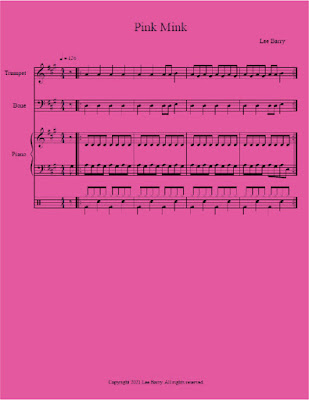
Pink Mink

Image
 Less glum, more fun for dark times.   Video        

Deus Ex Machina

Image
    January is Bb Lydian month. This piece is in a mixed meter ( 2 bars of 3/4, one bar of 4/4, 2 bars of 3/4, 1 bar of 5/4).

This Constant Beginning

Image
  The first piece of the New Year and The New Decade.

Peripherique

Image
Listen on Spotify What does funky bass music have to do with the 19th-century French sculptor Rodin?  Fragments. This is the best image that illustrates how I work when I produce albums.  I've always been a collector of ideas and have a good system for organizing them. It's essentially the process of serialization and generativity: making another piece in a series, transforming existing works into new ones, then framing them within some kind of a concept--as Rodin assembled fragments of sculptures.  I invent nothing, I rediscover.- Auguste Rodin "In later years, Rodin also used to tell the anecdote that the bust he originally intended to create had actually become a fragment, because as a young artist, he could not afford to heat his studio overnight. During a bitter cold winter night, the back of the 'Man with the Broken Nose' froze and broke off; this way from the bust only the face was left. Rodin officially favoured such accidental damages - at least he fa...

Locriane

Image
 A piece in E Locrian. Video:  https://youtu.be/px9Kl Hg6Yz4

Omenesque

Image
 

E-A-C#-E

Image
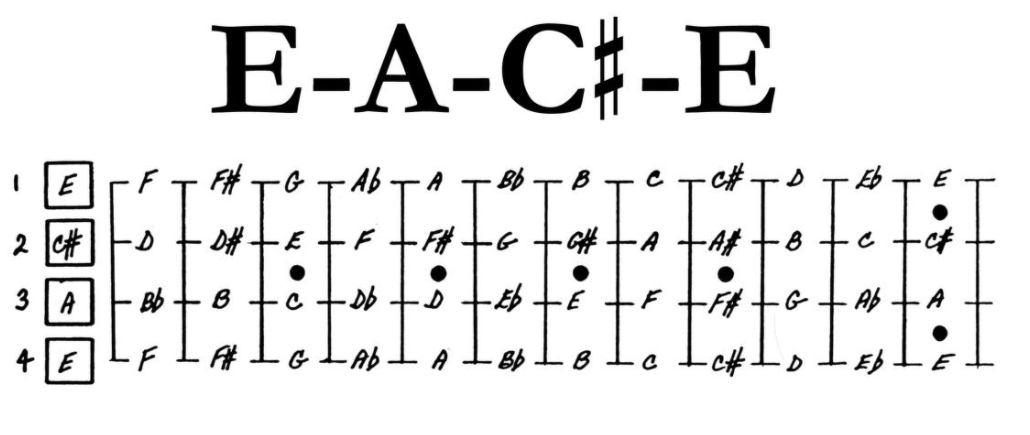
  I am using a capo at the 5th fret, which makes it more of a strummed chordal instrument or "rhythm guitar" rather than a bass--and a very short-scale bass--only 16 frets. These are some fairly easy shapes for both major and minor chords, and switching between them it's fairly easy. Essentially it’s an open-A tuning.

Alternate Tunings For Bass

Image
An idea generator.  Video Examples: The Original Book:     Alternate Tunings For Bass by Lee Barry is licensed under a Creative Commons Attribution-NonCommercial-ShareAlike 3.0 Unported License . Based on a work at www.box.net . Permissions beyond the scope of this license may be available at https://barrystudio.blogspot.com/2020/08/alternate-tunings-for-bass.html . Miscellaneous Loops/Demos:    HISTORICAL NOTE Unconventional tunings, or scordatura (It., from scordare, to mistune); were first used in the 16th century by Italian lutenists. They were primarily used to facilitate difficult passages, but also used to alter timbral characteristics, reinforce tonalities through the use of open strings, and to extend the instrument's range. Violin scordatura was employed in the 17th and 18th centuries by Italian and German composers, namely, Biagio Marini, Antonio Vivaldi, Johann Pachelbel and J.S. Bach; whose Fifth Suite for Unaccomp...