Posts

Showing posts from December, 2022

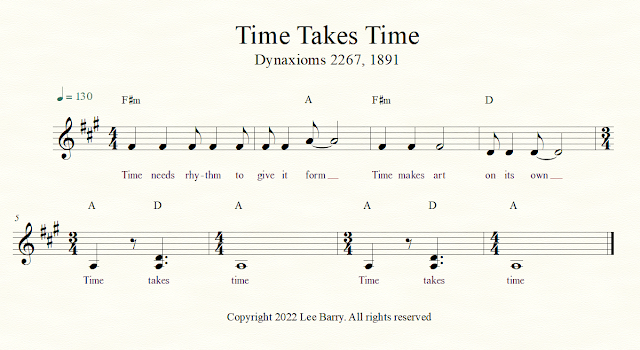
Time Takes Time

Image
  Last piece of music for 2022 with an upbeat mood and a riff on time, and 45 (47) seconds in length. In fact, it doesn't need to be any longer.  I did three bass parts:   Jazz Bass:  https://youtube.com/shorts/XilKxY8QXAc?feature=share Fretless:  https://youtube.com/shorts/-2bD0zlwwZw?feature=share MM:  https://youtube.com/shorts/7uLipaM0Ta0?feature=share Very often I'll "re-purpose" my aphorisms by using them for song lyrics if they sound musical. ("Aphoristic Pop").

Borrowed Chords

Image
  The technical term for "borrowed" chords is "modal interchange", meaning the universe of chords can be expanded from the seven chords available in the primary key through a reciprocal interchanging process. Using the metaphor of the solar system, with Earth as a starting point, the orbit of Mars is the first source of additional chords. If you are in a major key you can go there to obtain more chords from the parallel key (not relative key). In C, the parallel key is C minor, and vice-versa. Using the circle of fifths, the next "planet" is Jupiter, and would be G Major, or its relative minor, E minor. Since it has one sharp, it will give you all the chords that have F# in them, such as B Minor, D Major and D7. Using the circle of fourths , ascending from C, the next destination is F Major and F Minor, one flat and four flats respectively. This could give you access to Bb major and Bb minor triads, C7, Db Major, Eb and Eb7, G minor and G half-diminished ...

Interval Cubes

Image
  12 cubes (6x6x2) for each interval in the chromatic scale using only black, white and red. Can be displayed on a shelf, or hung on a wall. Each cube is currently prepared for shelf display with felt on the back edges to prevent cubes from scraping. The cubes can also be tiled together in different ways like building blocks to teach chords and intervals. A very unique work done in the style of Josef Albers or Alexander Calder. Work is fully documented on its own website for information and archival purposes. Cube 1. Unison Cube 2. Minor Second Cube 3. Major Second Cube 4. Minor Third Cube 5. Major Third Cube 6. Perfect Fourth Cube 7. Diminished Fifth Cube 8. Perfect Fifth Cube 9. Minor Sixth Cube 10. Major Sixth Cube 11. Minor Seventh Cube 12. Major Seventh

Interval Identification

Image
  To calculate an interval requires visualizing it on your instrument. This exercise helps both interval identification on the staff, as well as interval identification on guitar and or keyboards. It also gives you a good foundation for reading music. The mnemonic I've used here is: Some kind of C to some kind D is some kind of second. Some kind of C to some kind E is some kind of third. Some kind of C to some kind F is some kind of fourth Some kind of C to some kind G is some kind of fifth Some kind of C to some kind A is some kind of sixth Some kind of C to some kind B is some kind of seventh. But it will also need to be drilled beginning on D, E, F, G, A, and B, yet not on every chromatic scale degree: Db and D# are "some kind of D", Eb and E# are "some kind of E", and so on.  ***  Video Lesson: Quiz: Loading…

Poette

Image
  A piece exactly 60 seconds in length with a number sequence as lyrics. It can also be performed in reverse order. A fun game for children and adults alike. Tempo and bar lengths can be changed for the same 60-second target and lyrics can be swapped out for other sequences that are singable or otherwise musical. *** The AI-generated version. It understood the strophic rhythmic pattern in only 1 of 7 iterations, but the result is kind of interesting. It couldn't generate a similar result for the second "verse" with 1098, 765, etc. Different words can also be used to swap out the numbers. The voice it used was appropriately robotic.