Posts

Showing posts with the label Etudes

Heaven 11

A jazz head comprised of altered V-I cadences moving up in 4ths, using the raised 4th/11th as the altered note. They can be played as polychords (A/G, D/C, etc.) in a group situation, where the keyboards play the bottom triad and guitars play the top triad. Chord scales would be Lydian and Lyxian (a hybrid of Lydian and Mixolydian), or pentatonics.  Play at Musecore AI version, almost how it would sound with horns, I can't attest if it's following the changes, but the piece is such that attempting to play it might sound interesting, focusing on the what's in front of the slash, while the bass plays what's behind it--maybe the fifth

Cloud Dictionary (7/4 Etude)

Image
Cloud Dictionary (7/4 Etude) by meta4s

977

There are three repeating phrases, played over a span of 4 bars each, then played as a canon. The canon can be played in two ways: 1) as written or playing each pattern as many times as they want. I started with Pattern 1, then began playing them randomly. The player can decide how many bars to play each pattern: group of 9 notes beginning on A, group of 7 notes beginning on D, group of 7 notes beginning on E. What usually happens is once the “mesh” is created, there is no need to count. What you want to avoid are patterns of 4 because it becomes more locked and vertical]. 977 by meta4s

May 22nds

Image
5/22/1998 Constraints when composing music are necessary only to the point that the breaking of rules is necessary to finish the task.  [5/22/2025: When I studied with jazz composer Bill Russo, one of the rules was we couldn’t use dots or ties. I suppose you could start with those constraints but I couldn’t imagine a music that didn’t have syncopation. We couldn’t have jazz or rock’n’ roll without it so it was always ironic for me. There’s also the idea of “rule drift” where you build in that eventuality. Making something involves steering it to a conclusion, or is a process of “fixing” things that don’t work and rules don’t allow for that, so you “jailbreak” it].         *** The concept of "evil" manifests itself through art in many ways. Think of all the ways in which evil is depicted art through human history, then think how that look of evil would sound. Manipulation of sound, especially through electronic media, is a way to express those...

Minor Chords A Major Third Apart

Image
  The AI interpretation. It develops it like a pop song, which doesn't fit. This is just a head and improvisations would be on those 2 chords, or transposed, e.g. C#m7/Am7  

Ramakrishna (Bhajan Cycle)

Image
 

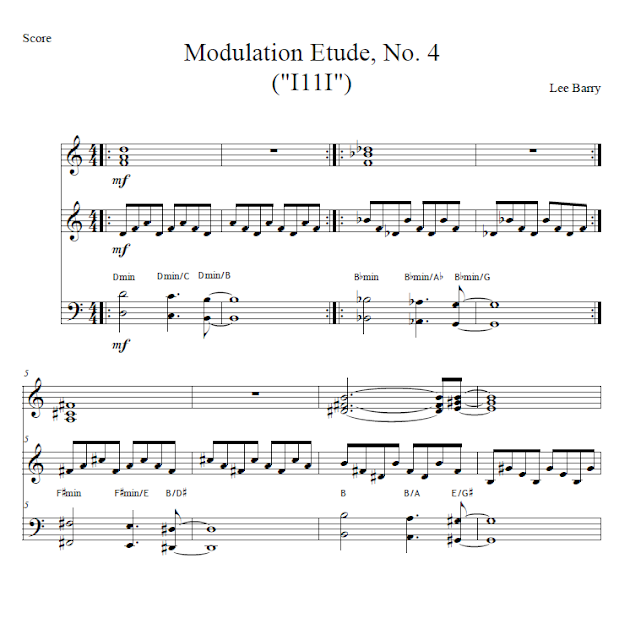
Modulation Etude No. 4

Image
A chord cycle with descending bass lines, under minor chords a major third apart. Score MIDI Audio

Harmonic Cycling

Image
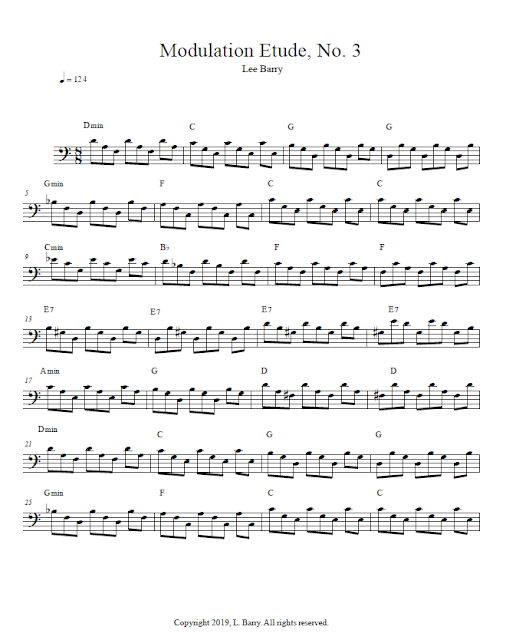
A harmonic etude that is essentially a variant on the ii-V-i progression, but is rather ii-VII-V, with the V chord switching to the minor mode at the beginning of each progression. (It can also be thought of as v-IV-I in the Mixolydian mode). A piece I composed on the Etude, Day and Age Cycle for the verses: D-/C/G G-/F/C C-/Bb/F Turnaround (E7) A-/G/D The complete cycle around the circle of fourths: D-/C/G G-/F/C C-/Bb/F F-/Eb/Bb Bb-/Ab/Eb Eb-/Db/Ab G#-/F#/C# C#-/B/F# F#-/E/B B-/A/E E-/D/A A-/G/D Audio File The lead sheet:  

Figured Basses

Image
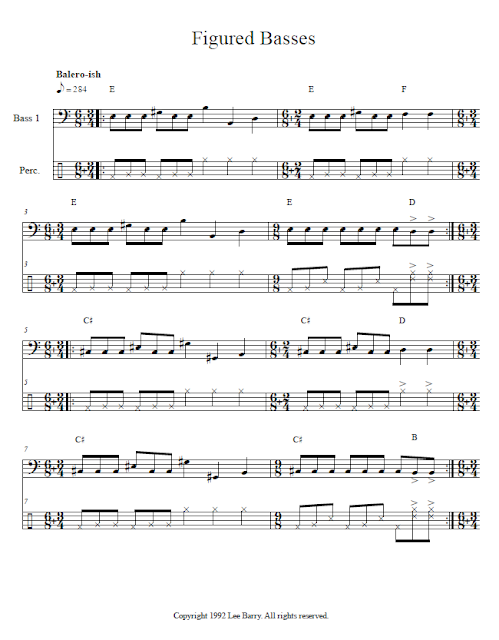
A piece based on a compound time signature and cycles through 4 dominant 7th chords a minor third apart: E7, C#7, Bb7, G7. This is a re-track as an etude and has three bass parts. To get through all 12 keys use the two other cycles: F7-D7-B7-Ab7 and F#7-Eb7-C7-A7.  The MIDI Loop to play along with. (Note that Musecore notated it wrong. It is 6/8+3/4, not 3/4)   Rhythm By Addition by Lee Barry Video: The String Shortet Shortet No. __ (Figured Basses) by meta4s The 41/8 Version:  Figured Basses (41-8 Version) by meta4s