Posts

Showing posts with the label Music Theory

Base 12 Symmetries in Music

Image
 From Islamic Design: A Genius For Geometry      

Harmonic Cycling

Image
A harmonic etude of ii-I-Vs through the circle of 4ths. The complete cycle modulating up in 4ths through all 12 keys: D-/C/G G-/F/C C-/Bb/F F-/Eb/Bb Bb-/Ab/Eb Eb-/Db/Ab G#-/F#/C# C#-/B/F# F#-/E/B B-/A/E E-/D/A A-/G/D    

Songs With Bridges

Image
  Sunken Bridge by RO&AD Worth re-posting. I haven't tested the links so some may be dead.   7/30/2011 At the theoretical level, song hooks are imbued with clever twists like harmonic modulations, chord 'borrowing' and turnarounds. Now these devices have devolved from the songwriter's toolkit in much the same way Cole Porter Moon-June rhyming schemes became obsolete by the 1960s in favor of new compositional devices that made them frumpy and old hat. The classic bridge is now in this category. Nonetheless I still love to put them in songs. Bridges (sometimes used synonymously with middle-eight ) are difficult to do well because not any musical transition can qualify as a bridge device. They typically appear only once in a composition: If a section is repeated, it technically is not a bridge. Some regard the "life is very short..." phrase in the Beatles' "We Can Work It Out" or the "why she had to go..." phrase in "Yesterday...

Dynaxiom 3529

Image
   Theory is a way to fully understand something, but not to the extent that you could successfully apply it. Applying knowledge requires giving shape so that you can examine it. You could have ideas for a sculpture, and you could know lots of theory on some other subject that could be applied conceptually, but attention has to be paid to that particular form, because that's what others see. In music, you can know theory, and you can apply it to form, but it's a question of theory serving the idea.  I recall an anecdote about The Beatles discovering the B7 chord, and it opened up new possibilities. You could later learn that it's the dominant chord in E minor, and you could continue to study functional harmony because it's interesting, but it still has to be applied, or simply used in the flow of your work. Harmony is, in fact, functional and is ready to be applied, but how does it serve the art? Jazz is harmonic (or vertical) by its nature, and theory guides its compos...

Experiments In Musical Intelligence

Image
 The Lego Model (Source Music II LLM)   

Music LLMs

Image
   Excerpt Library (Music I) The provided sources encompass a wide-ranging collection of texts addressing music theory, film studies, artificial intelligence, cognitive science, and cultural history . Music Theory and Compositional Practice These sources provide both historical and technical perspectives on the creation of music. Terence Dwyer offers a practical guide to musique concrète , focusing on using tape recorders as instruments to manipulate sounds through speed changes, reversals, and editing. Paul Hindemith details a rigorous system for two-voice composition , emphasizing the importance of tonal higher-units and degree-progressions. Igor Stravinsky reflects on the dogmatic element of order in music, arguing that composition is a work of selection and that music is "powerless to express anything at all" beyond its own form. Edgard Varèse advocates for the "liberation of sound," defining music as the "corporealization of the intelligence that ...

AI Music Teacher

Image
Imagine it's 1979 and you have been playing bass for just 2 years and you're using AI as your teacher.  Source: Excerpt Library (Music Theory Articles 1979-1999)  

Curio No. 12

Image
    An interesting device for improvisations (or compositions) is to use a chord in fourths as the primary harmonic element and the major pentatonic scale based on the top note of the voicing, for example using an E Major pentatonic against a chord stacked F#-B-E. Only those notes should be used but you can use other scales such as E Lydian.  Curio No. 12 by meta4s   Version 2 with chimes and choir:  Curio No. 12 (Ver. 2) by meta4s

Interval Cubes

Image
Interval Cubes Acrylic on panels (2013) P.O.R.    Inquire Download symbol (block) grid. (Adobe Illustrator) 12 cubes (6x6x2) for each interval in the chromatic scale using only black, white and red. Can be displayed on a shelf, or hung on a wall. Each cube is currently prepared for shelf display with felt on the back edges to prevent cubes from scraping. The cubes can also be tiled together in different ways like building blocks to teach chords and intervals. A very unique work done in the style of Josef Albers or Alexander Calder. Work is fully documented on its own website for information and archival purposes. Cube 1. Unison Cube 2. Minor Second Cube 3. Major Second Cube 4. Minor Third Cube 5. Major Third Cube 6. Perfect Fourth Cube 7. Diminished Fifth Cube 8. Perfect Fifth Cube 9. Minor Sixth Cube 10. Major Sixth Cube 11. Minor Seventh Cube 12. Major Seventh A symbol grid in Adobe Illustrator [Download .ai file] Drag symbols (blocks) and rearran...

Anacruses

Image
  The word "cover" is a "downbeat" word; you can't speak it on an upbeat, but in music you can use it for funky rhythmic effects. Here it sounds Latin, and "running for cover" is spoken like "oye como va". You can use all kinds of lyric variations on the same rhythm, or even just use "oye como va", which inverts the word "como" to an "upbeat" word, and sounds like "let me come over". Running For Cover (Oye Como Va?) (12-21) by meta4s

Minor Chords A Major Third Apart

Image
  The AI interpretation. It develops it like a pop song, which doesn't fit. This is just a head and improvisations would be on those 2 chords, or transposed, e.g. C#m7/Am7  

Dyads From Triads

Image

Voicings Versus Inversions

Image
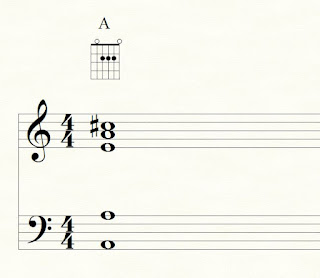
A voicing is essentially a redistribution of chord tones, a metaphor taken from SATB voices. For an A major triad there are 3, here in close-position (within an octave), but can be voiced in open-position with the chord tones more spread out.   An inversion is created by the bass notes. To play a root-position triad you play A in the bass and play one of the voicings in the right hand. Playing C# in the bass (and any voicing) creates a first inversion triad. Playing E in the bass (and any voicing) creates a second inversion triad. A simple example of the use of inverted triads is a descending bass line in a scalar pattern (A, G#, F#, E, D, C#, B, A): The chord symbols with the slash behind them are the inversions. You can play these on a guitar, but you will need the contrapuntal bass line to hear the inversions. Simply playing D/F# with the F# on the bottom of the voicing will essentially be more of a voicing. 

 Modes and Pseudokeys

Image
The way I've always understood modes is through parent major scales. The  parent major scale for D Dorian is C major, as is E Phrygian, F Lydian, G Mixoydian, A Aeolian and B Locrian. The best way to hear what modes sound like is on a keyboard with both hands, as opposed to just playing the scale on a guitar or horn. To hear what F Lydian sounds like, play F in the bass and play all the white keys, focusing in on the characteristic note, the #4 (augmented 4th), from the root of the mode, not the root of the parent scale . For G Lydian, play G in the left hand and play a D major scale, again focusing on the #4 (C#). "Pseudokeys" are keys which function like normal keys and have a tonal center, albeit weaker. The most usable pseudokeys are Dorian, Lydian, and Mixolydian, and of course, Aeolian, which is the minor mode. Each of them have unique characteristics: Dorian has a major sixth, in contrast to the minor sixth in natural minor. Lydian has the raised fourth. The I chor...

Interval Visualization

Image
Calculation of intervals involves some kind of mnemonic or other ways of visualizing them. This is unnecessary when sight-reading because the process of seeing notes and rhythms on a staff and playing them assumes you know what's under your fingers. It's very much like touch-typing. *** Quiz: Loading…

Borrowed Chords

Image
  The technical term for "borrowed" chords is "modal interchange", meaning the universe of chords can be expanded from the seven chords available in the primary key through a reciprocal interchanging process. Using the metaphor of the solar system, with Earth as a starting point, the orbit of Mars is the first source of additional chords. If you are in a major key you can go there to obtain more chords from the parallel key (not relative key). In C, the parallel key is C minor, and vice-versa. Using the circle of fifths, the next "planet" is Jupiter, and would be G Major, or its relative minor, E minor. Since it has one sharp, it will give you all the chords that have F# in them, such as B Minor, D Major and D7. Using the circle of fourths , ascending from C, the next destination is F Major and F Minor, one flat and four flats respectively. This could give you access to Bb major and Bb minor triads, C7, Db Major, Eb and Eb7, G minor and G half-diminished ...

Interval Cubes

Image
  12 cubes (6x6x2) for each interval in the chromatic scale using only black, white and red. Can be displayed on a shelf, or hung on a wall. Each cube is currently prepared for shelf display with felt on the back edges to prevent cubes from scraping. The cubes can also be tiled together in different ways like building blocks to teach chords and intervals. A very unique work done in the style of Josef Albers or Alexander Calder. Work is fully documented on its own website for information and archival purposes. Cube 1. Unison Cube 2. Minor Second Cube 3. Major Second Cube 4. Minor Third Cube 5. Major Third Cube 6. Perfect Fourth Cube 7. Diminished Fifth Cube 8. Perfect Fifth Cube 9. Minor Sixth Cube 10. Major Sixth Cube 11. Minor Seventh Cube 12. Major Seventh

Interval Identification

Image
  To calculate an interval requires visualizing it on your instrument. This exercise helps both interval identification on the staff, as well as interval identification on guitar and or keyboards. It also gives you a good foundation for reading music. The mnemonic I've used here is: Some kind of C to some kind D is some kind of second. Some kind of C to some kind E is some kind of third. Some kind of C to some kind F is some kind of fourth Some kind of C to some kind G is some kind of fifth Some kind of C to some kind A is some kind of sixth Some kind of C to some kind B is some kind of seventh. But it will also need to be drilled beginning on D, E, F, G, A, and B, yet not on every chromatic scale degree: Db and D# are "some kind of D", Eb and E# are "some kind of E", and so on.  ***  Video Lesson: Quiz: Loading…

Chord Scale Alternation

Image
  A 2-chord Joe (Am/Ebmaj7(#11)) using two chord scales: A minor pentatonic (or A natural minor) and Eb Lydian. Or you could use a C major scale alternating with a Bb major scale, or C major pentatonic and Bb major pentatonic. The key is to alternate between the B-natural and Bb and E-natural and Eb as the chords change. In some metaphorical way, the Bs and the Es are "mirror reflections" or opposite. Etude: Chord Scale Alternation by meta4s

September 20ths

Image
9/20/2005                     On the advent of cell phone video: Is it a new medium? How does it affect perception?  [Musing On Music Mostly LLM: Prompt: " Discuss the evolution of film and video and its effect on perception "]      9/20/2016             What all musicians should love is the process, both at compositional and performance levels. Sometimes I love the potential in ideas that I get, even if the first demos don’t fully express or resolve them. If all I get is a nice set of changes, I feel a sense of satisfaction and/or relief that the muse is still there.             9/20/2017             Orange Peel, 19 x 25 inches, acrylic on paper with iridescent copper patina. (Third in the ‘Leaf’ series (Goldleaf, Silverleaf). Copper patina makes the work bright and pastel in sunlight and darker and dramatic...